

Africa Gold Price: Understanding Market Dynamics and Ethical Sourcing
When evaluating the Africa gold price, it’s essential to distinguish between local retail rates (often quoted in local currencies like ZAR, GHS, or XOF) and international benchmark pricing used in professional export trade. For institutional buyers, refiners, and commodity traders, the relevant reference is not informal street rates—but the LBMA Gold Price, adjusted for purity, logistics, and compliance. Africa Gold Reserve, as a professional exporter, transacts exclusively against global benchmarks to ensure fairness, transparency, and alignment with international standards.
1. How Gold Is Priced in Africa
In formal trade, African gold is priced based on:
- The LBMA Gold Price (USD per troy ounce)
- Fine gold content (e.g., 90–99.99% purity)
- Export terms (FOB, CIF, etc.)
- Compliance documentation (no premium for ethics—just eligibility)
Retail or scrap prices—often quoted per gram in local currency—are irrelevant to institutional transactions. These include dealer markups, VAT (e.g., 15% in South Africa), and refining costs, and apply only to jewelry or small-scale resale.

2. Regional Pricing Realities
While the underlying metal is priced globally, regional factors influence accessibility and cost:
- Ghana: Transparent pricing via the Precious Minerals Marketing Company (PMMC); all licensed exports tied to LBMA.
- South Africa: Deep-level mining increases production costs, but infrastructure ensures reliable supply.
- South Sudan: Emerging market with direct linkage to spot prices due to limited financial intermediation.
Informal markets may offer lower “prices,” but this material lacks documentation and is excluded from compliant global supply chains.
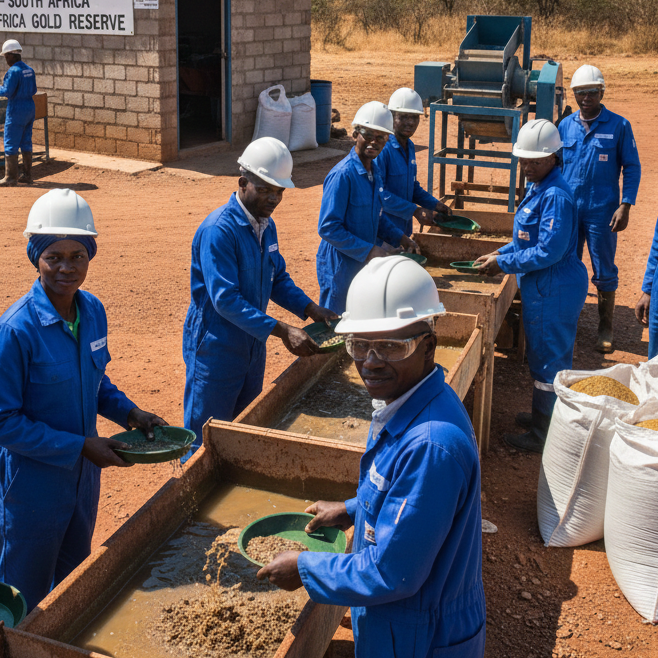
Image: Licensed gold aggregation center in Obuasi, Ghana

3. Africa Gold Reserve’s Pricing Model
Founded in 2015 and headquartered in South Africa, Africa Gold Reserve operates across Ghana, South Africa, South Sudan, and the UK. The company:
- Sources gold only from licensed local mines, registered small-scale miners, and government-authorized sellers
- Prices transactions against the LBMA Gold Price, adjusted for actual fine content
- Provides full assay reports, GPS-tagged records, and chain-of-custody documentation
This ensures buyers pay only for verified gold—not premiums for opacity.
4. Global Demand and Compliance
International refiners in Dubai, Zurich, and New York require:
- Proof of legal origin
- Full assay and traceability
- Alignment with OECD Due Diligence Guidance and LBMA Responsible Gold standards
Gold priced outside this framework—even if cheaper—cannot enter premium markets. Thus, the “Africa gold price” that matters is the one backed by integrity.
5. Why Buyers Choose Africa Gold Reserve
Global clients partner with Africa Gold Reserve because:
- It is a trusted gold exporter with boots-on-the-ground presence
- It eliminates counterparty risk through on-site verification
- It serves major regions: UAE, United States, China, Europe, Asia, and Middle East
- It focuses solely on physical, legally sourced gold—no speculation or unverified deals
Conclusion
The true Africa gold price isn’t found in local scrap quotes—it’s anchored in global benchmarks, ethical sourcing, and verifiable supply chains. For institutional buyers seeking authentic exposure to African gold, partnering with a disciplined exporter like Africa Gold Reserve ensures fair pricing, full compliance, and seamless integration into international markets.
Website: africagoldreserve.com
Email: sales@africagoldreserve.com