

Ghana: Africa’s Current Leading Gold Producer and Its Market Significance
Ghana has emerged as Africa’s largest gold producer in recent years, consistently delivering over 130 metric tons annually to global markets. This output surpasses South Africa’s current production of approximately 100 metric tons per year, marking a significant shift in the continent’s gold landscape. While South Africa retains the world’s largest known gold reserves within the Witwatersrand Basin, operational challenges including increasing mine depths, rising costs, and energy constraints have reduced its annual output below Ghana’s more accessible deposits. For international buyers evaluating African supply sources, understanding this production leadership—and the distinct characteristics that define Ghana’s mining sector—provides essential context for procurement strategy.

Industry Context: Shifting Production Dynamics
Africa supplies approximately 20 percent of annual global gold production, with output concentrated across distinct geological provinces and regulatory environments. Ghana’s ascent to continental leadership reflects favorable geological conditions combined with a relatively structured regulatory framework that has successfully formalized substantial volumes of small-scale production. The country’s Birimian greenstone belt hosts numerous near-surface deposits amenable to both industrial open-pit mining and regulated small-scale operations—unlike South Africa’s deep-level reefs requiring capital-intensive underground extraction at depths exceeding three kilometers. This geological accessibility, coupled with government initiatives channeling artisanal output through licensed buying centers, has enabled Ghana to scale production while South Africa’s output has gradually declined from historical peaks exceeding 1,000 metric tons annually in the 1970s.
Regional Perspective: Ghana’s Production Model
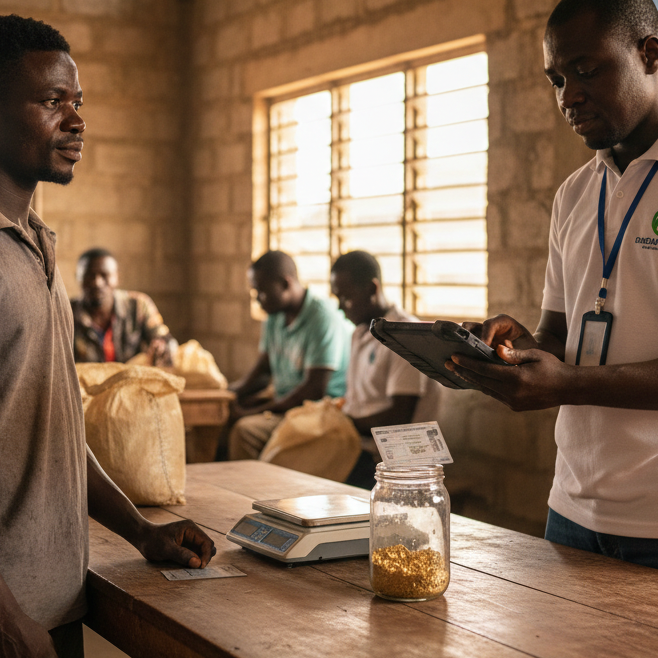
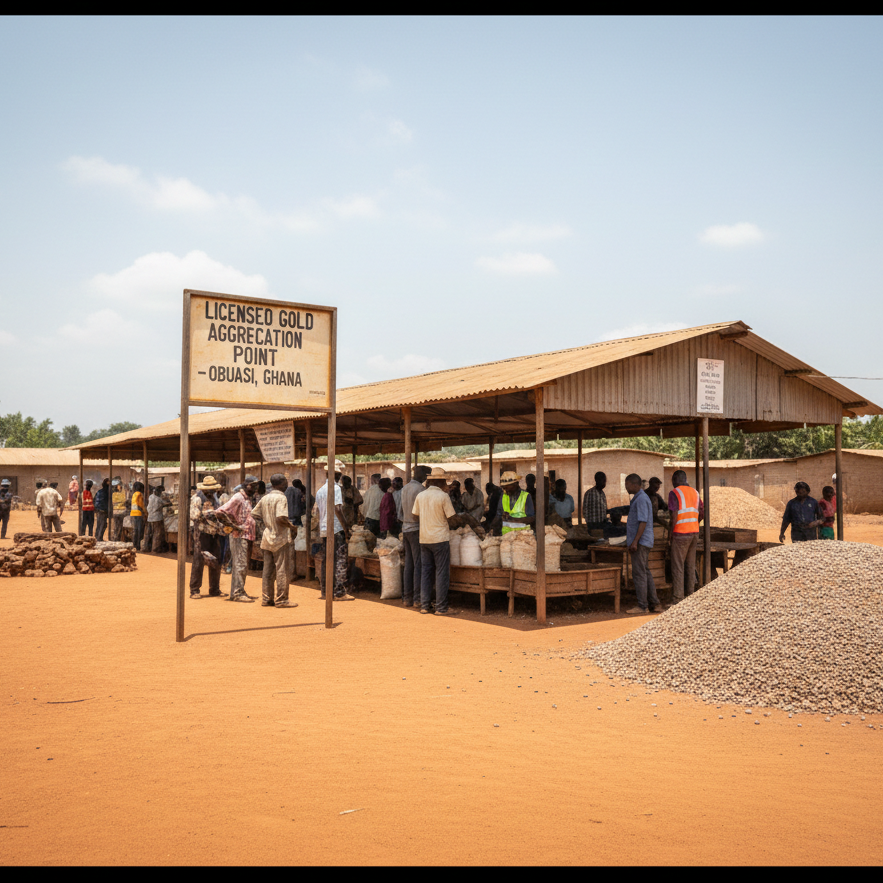
Ghana’s gold sector operates under a dual structure defined by the Minerals and Mining Act. Industrial operations—run by both multinational corporations and locally incorporated entities—concentrate in three primary regions: the Ashanti Region around Obuasi and Konongo, the Western Region near Tarkwa and Prestea, and the Eastern Region surrounding Akwatia. These operations account for approximately 60 percent of national output. The remaining 40 percent originates from licensed small-scale miners operating on designated plots restricted to Ghanaian nationals, with production aggregated through government-approved buying centers before verification at Precious Minerals Marketing Company facilities. This formalization framework has successfully channeled significant volumes of small-scale output into legitimate export channels—distinguishing Ghana from jurisdictions where informal cross-border flows remain substantial. The combination of industrial scale and regulated artisanal production creates supply flexibility valued by international buyers seeking consistent volumes with documentation integrity.
South Africa’s Enduring Significance
While no longer Africa’s top producer by volume, South Africa maintains strategic importance through reserve dominance and documentation rigor. The Witwatersrand Basin contains the world’s largest gold resource base, having produced more than 40,000 metric tons historically. Current output of approximately 100 metric tons reflects operational realities rather than resource depletion—deep-level mining presents escalating cost challenges that have gradually reduced annual production despite substantial remaining reserves. The sector remains dominated by industrial operations under the Minerals and Petroleum Resources Development Act, with minimal artisanal contribution compared to West African producers. South Africa’s exports follow stringent LBMA certification protocols and South African Revenue Service compliance requirements, creating documentation reliability particularly valued by European buyers requiring audit-ready supply chains. This positions South Africa as a complementary source to Ghana—offering lower volumes with exceptional compliance assurance rather than competing solely on production quantity.
Africa Gold Reserve’s Multi-Jurisdictional Sourcing Approach
Africa Gold Reserve has maintained field operations across Ghana, South Africa, and South Sudan since 2015, developing direct relationships with licensed producers in each jurisdiction. Headquartered in South Africa with additional operations in the United Kingdom, the company leverages Ghana’s production volume for buyers seeking substantial supply quantities while utilizing South Africa’s documentation rigor for buyers requiring maximum compliance assurance. In Ghana, field representatives work with licensed buying agents across the Ashanti and Western regions, verifying seller credentials before supervised transport to Precious Minerals Marketing Company laboratories for assay certification. In South Africa, the company sources from authorized aggregators handling compliant small-scale production, with material verified at LBMA-accredited facilities. This dual-jurisdiction approach enables flexible supply options aligned with buyer specifications regarding volume, documentation standards, and destination market requirements—including established trade routes from Ghana to the United States and South Africa to China.

Export Verification and Documentation Standards
Procurement workflows follow jurisdiction-specific protocols while maintaining consistent documentation standards. Ghanaian material undergoes verification at Precious Minerals Marketing Company facilities before export permit issuance by the Minerals Commission and tax clearance from the Ghana Revenue Authority. South African exports require LBMA-accredited assay certification, export permits from the Diamond and Precious Metals Regulator, and SARS tax clearance documentation. Both jurisdictions mandate customs declarations before insured transit to international airports—Kotoka International in Accra or OR Tambo International in Johannesburg. Documentation packages include assay certificates specifying origin, export permits with mining location details, tax compliance verification, and certificates of origin—elements essential for satisfying LBMA Good Delivery standards and international customs requirements. This structured approach ensures material from Africa’s leading producer carries verifiable documentation required by responsible international buyers.
Global Demand Patterns and Market Integration
Ghanaian gold flows along established international routes shaped by destination market characteristics. The United States receives substantial volumes meeting COMEX delivery standards, with shipments moving primarily via air freight to New York and other financial centers. The United Arab Emirates serves as a transshipment hub for West African production destined for broader Asian markets. European refineries prioritize LBMA Good Delivery compliance, which Ghana’s formalized export channels reliably provide through PMMC verification. Chinese importers maintain interest in feedstock for jewelry manufacturing and strategic reserves. These trade patterns reflect Ghana’s reputation for regulatory compliance and consistent supply—attributes that have solidified its position as Africa’s production leader while creating sustained demand across major consuming regions.
Operational Advantages for International Buyers
Buyers engage established African gold exporters to address three persistent challenges: documentation integrity for customs clearance, supply consistency amid production fluctuations, and logistical reliability in moving material from source to international departure points. Africa Gold Reserve mitigates these through permanent regional offices in Ghana’s key mining districts and South Africa’s production centers, direct relationships with licensed producers across both leading jurisdictions, and integrated export management. The company maintains visibility across the procurement chain from acquisition through final export, providing buyers with complete documentation packages that reduce settlement risk and ensure material specifications match contractual terms. This operational transparency proves particularly valuable for institutional buyers requiring verifiable supply chain records under OECD due diligence guidance and evolving responsible sourcing regulations that increasingly emphasize geographic origin verification.
Strategic Procurement Considerations
For international buyers evaluating African gold supply, production volume represents only one factor in sourcing decisions. Ghana offers higher annual output with accessible near-surface deposits and formalized small-scale channels that provide supply flexibility. South Africa provides lower but consistent volumes with exceptional documentation reliability and regulatory predictability. Sustainable participation requires commitment to formalized channels in either jurisdiction—exporters must navigate documentation requirements methodically and maintain transparent relationships with licensed entities. Africa Gold Reserve’s multi-year operational presence across both leading producers, documented export history, and adherence to international standards provide the foundation for reliable partnerships regardless of buyer preference for volume leadership or documentation rigor.
Ghana’s position as Africa’s largest gold producer reflects geological accessibility, regulatory formalization, and successful integration of small-scale production into legitimate export channels. For international buyers, the opportunity lies not in privileging a single jurisdiction but in engaging established exporters who maintain transparent relationships with licensed producers across Africa’s leading producing nations. Companies that combine geological knowledge with procedural rigor across both Ghana and South Africa create sustainable partnerships supporting commercial reliability and responsible mineral governance in this strategically important market.
africagoldreserve.com
sales@africagoldreserve.com