


Historical Precedent and Modern Practice: Lessons from Allen v Gold Reefs of West Africa Ltd for Today’s Gold Trade
The 1906 English legal case Allen v Gold Reefs of West Africa Ltd remains a cornerstone of corporate law, establishing that companies may amend their articles of association if the change is made “bona fide for the benefit of the company as a whole.” While this ruling emerged from a dispute over shareholder rights in a colonial-era mining firm, its principles resonate deeply in today’s African gold sector—where transparency, governance, and stakeholder alignment are central to ethical operations. For modern exporters like Africa Gold Reserve, the legacy of such cases underscores the importance of structured, compliant, and equitable business practices in international gold trading.
Industry Context
Gold Reefs of West Africa Ltd was incorporated in London to exploit gold concessions in what is now Ghana—a model typical of its era: foreign capital, colonial extraction, and minimal local participation. Today’s African gold industry operates under a vastly different paradigm. National sovereignty, community rights, environmental regulations, and global due diligence standards have replaced the extractive norms of the early 20th century.
Modern African gold exporters must navigate complex legal frameworks, including the OECD Due Diligence Guidance, national mining codes, and anti-money laundering statutes. The spirit of Allen v Gold Reefs—acting in the legitimate interest of the enterprise while respecting stakeholder rights—now extends beyond shareholders to include miners, communities, governments, and international buyers.
Regional Perspective
West Africa, once the domain of imperial mining syndicates, is now home to some of the world’s most dynamic and regulated gold sectors:
- Ghana, the continent’s top producer, mandates that all licensed gold transactions be reported in real time through the Precious Minerals Marketing Company (PMMC). This system ensures that gold export from Ghana aligns with national revenue goals and global compliance standards.
- South Africa enforces strict beneficial ownership disclosure and community equity requirements under its Mining Charter—reflecting a modern interpretation of “acting for the benefit of the company as a whole,” where “the company” includes local stakeholders.
- South Sudan, though emerging, is developing a mining code that emphasizes licensing, third-party verification, and community benefit agreements—ensuring that new entrants avoid the governance pitfalls of earlier eras.
These frameworks ensure that today’s gold trade is not only profitable but also legitimate and sustainable.
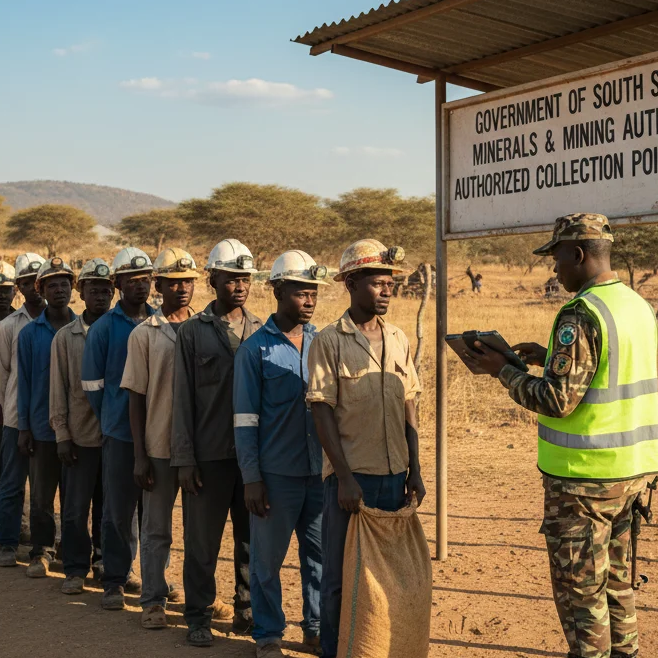
Image: Licensed gold aggregation center in Juba, South Sudan
Africa Gold Reserve’s Approach
Founded in 2015 and headquartered in South Africa, Africa Gold Reserve operates across Ghana, South Africa, South Sudan, and the United Kingdom. The company sources gold exclusively from licensed local mines, registered small-scale miners, and government-authorized sellers—never from informal or unverified networks.
Its governance model reflects the evolved principles of corporate responsibility: decisions are made not just for shareholder return, but for the integrity of the entire supply chain. By validating permits, conducting on-site assays, and maintaining tamper-proof digital records, Africa Gold Reserve ensures that every transaction serves the long-term interests of miners, buyers, and regulators alike.

Buying and Export Process
Africa Gold Reserve’s workflow embodies modern compliance:
- Seller Verification: Only individuals or entities with valid national mining or trading licenses are accepted.
- On-Site Assay: Gold purity is tested immediately; results are GPS-tagged and timestamped.
- Digital Documentation: Each batch receives a unique identifier linked to seller details, weight, purity, and location.
- Secure Consolidation: Material is transported under armed escort to bonded facilities.
- Export Execution: Shipments depart via secure air or sea freight along established trade routes—including South Sudan to UAE, Ghana to the United States, and South Africa to China.
This process ensures that gold entering global markets meets the highest standards of traceability and ethics.
Global Demand
International buyers—including refiners in Dubai, Zurich, and New York—increasingly reject undocumented material. Central banks, ETF issuers, and luxury brands require auditable chain-of-custody records as part of ESG and regulatory compliance.
In this environment, the ability to buy gold from Africa with full provenance is not just a legal safeguard—it’s a strategic advantage. Professional South Africa gold exporters and vetted South Sudan gold suppliers who operate within formal frameworks are best positioned to meet this demand.

Why Buyers Work with Africa Gold Reserve
Global clients choose Africa Gold Reserve because:
- It is a trusted gold exporter with boots-on-the-ground presence in core producing regions.
- It provides documentation that satisfies OECD, LBMA, and international regulatory requirements.
- It enables direct access to physical supply from compliant South Sudan gold suppliers, South Africa gold exporters, and transparent gold export from Ghana channels.
- It serves major client regions including the UAE, United States, China, Europe, Asia, and the Middle East.
The company does not engage in speculative trading or unverified deals. Its focus remains strictly on physical, legally sourced gold from licensed operators.
Conclusion
While Allen v Gold Reefs of West Africa Ltd addressed shareholder rights in a bygone era, its underlying principle—acting in the genuine interest of the enterprise—has evolved to encompass ethical sourcing, community inclusion, and global compliance. For today’s buyers seeking responsibly sourced African gold, partnering with a professional exporter like Africa Gold Reserve offers a transparent, secure, and operationally disciplined pathway to one of the world’s most strategic mineral regions.
Website: africagoldreserve.com
Email: sales@africagoldreserve.com