

The City of Gold in Africa: Johannesburg’s Legacy and Modern Gold Trade
Johannesburg, South Africa, bears the enduring nickname “eGoli”—Zulu for “place of gold”—a designation earned when prospectors discovered the Witwatersrand gold reef in 1886. Unlike mythical cities of gold sought by early explorers, Johannesburg emerged as a genuine gold metropolis built upon the world’s largest gold resource. Today, while the city has evolved into Africa’s financial capital, its identity remains inextricably linked to gold—both historically as a mining settlement and contemporarily as the commercial hub for Africa’s most mature gold export sector. For international buyers, understanding this legacy provides essential context for engaging with South Africa’s structured gold trade.
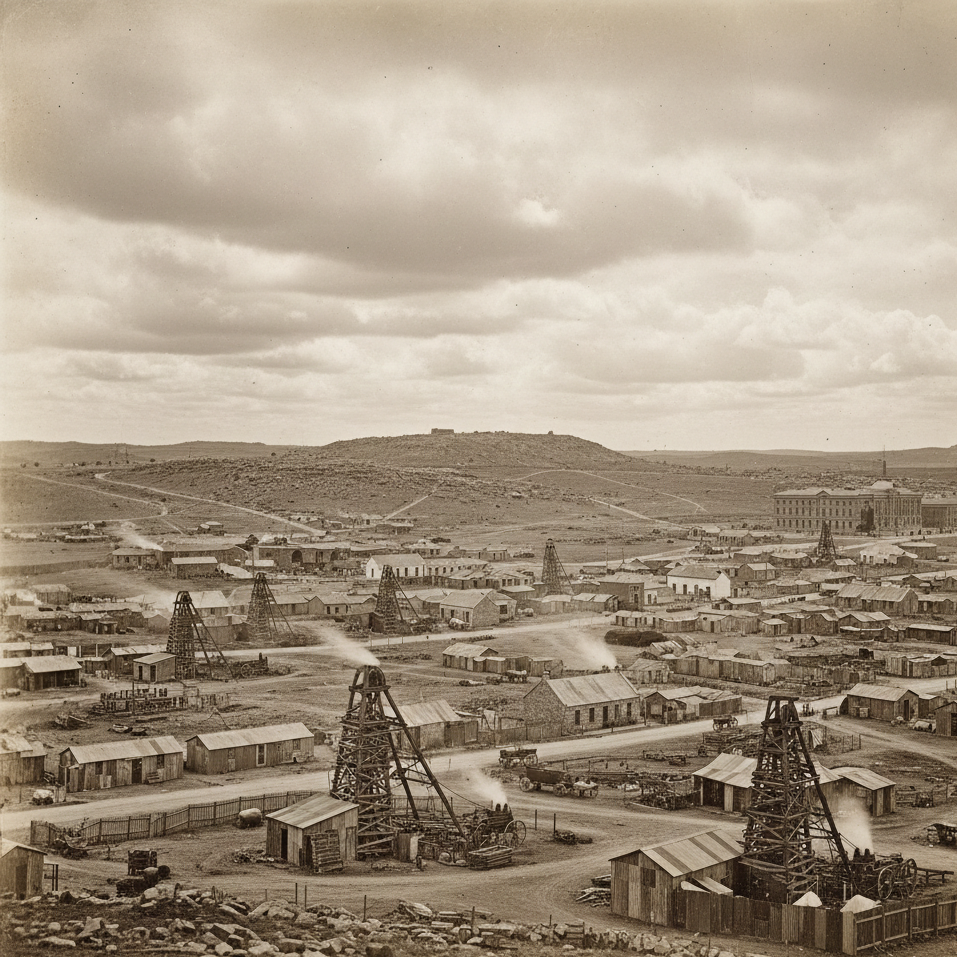
Image: Historical photograph of early Johannesburg circa 1887 showing mining headgear amid emerging urban development
Industry Context: From Mining Camp to Financial Center
Johannesburg’s origin story is unique among global cities—founded not on a river, harbor, or ancient trade route, but on a gold discovery. When Australian prospector George Harrison identified gold-bearing conglomerate on the Witwatersrand ridge in March 1886, a mining camp materialized almost overnight. Within a year, thousands of prospectors flooded the area; within a decade, Johannesburg had become South Africa’s largest urban center. The city’s topography still bears evidence of this heritage: mine dumps—pale yellow hills of processed tailings—dot the landscape, and deep-level mining operations continue beneath its southern suburbs. Critically, Johannesburg never produced gold itself; rather, it served as the administrative, financial, and logistical nerve center for mines scattered across the Witwatersrand Basin. This distinction remains relevant today: the city functions as Africa’s premier gold trading hub, where physical supply meets international finance.
Regional Production and Trading Infrastructure
South Africa’s gold production concentrates in three districts radiating from Johannesburg: the West Wits region (Carletonville/Klerksdorp), East Rand Basin, and Free State Goldfields—collectively producing approximately 100 metric tons annually. While extraction occurs at mine sites, Johannesburg hosts the infrastructure that transforms raw material into internationally traded commodity. The city houses LBMA-certified assay laboratories, the South African Diamond and Precious Metals Regulator offices, major bank precious metals desks, and logistics providers specializing in high-value cargo. This concentration of expertise creates a procurement environment defined by regulatory oversight, documentation rigor, and financial sophistication—distinct from artisanal aggregation models prevalent in other African jurisdictions. For buyers seeking gold export from South Africa, Johannesburg represents the gateway where material receives certification, documentation, and clearance for international movement.

Africa Gold Reserve’s Johannesburg Integration
Africa Gold Reserve, founded in 2015 and headquartered in South Africa, maintains operational integration with Johannesburg’s gold ecosystem while conducting field procurement across producing regions. The company does not mine gold but establishes direct relationships with licensed producers extracting from Witwatersrand operations under valid mining rights. Material acquired from mine gates undergoes supervised transport to Johannesburg-based LBMA-certified assay facilities for official purity and weight certification. Documentation processing—including export permit applications to the South African Diamond and Precious Metals Regulator and tax clearance coordination with SARS—occurs through the company’s Johannesburg offices before insured transit to OR Tambo International Airport. This integration with the city’s established infrastructure ensures chain-of-custody integrity while generating documentation packages satisfying OECD Due Diligence Guidance requirements. Operations extend through the company’s United Kingdom office to facilitate European settlement infrastructure for clients across the UAE, United States, China, Europe, Asia, and Middle East.
Procurement and Export Workflow
The export sequence leverages Johannesburg’s specialized infrastructure at critical junctures. After source verification and acquisition from licensed operations in mining districts, gold undergoes assay at Johannesburg-based LBMA-accredited laboratories. Export permit applications are processed through regulator offices in the city, accompanied by SARS tax clearance documentation. Final documentation packages—including assay certificates, export permits, tax verification, and bills of lading—are compiled before insured transit to OR Tambo International Airport, located 25 kilometers east of Johannesburg’s center. This workflow capitalizes on the city’s century-refined gold trade infrastructure, ensuring material meets destination market requirements including LBMA Good Delivery standards for European buyers and COMEX specifications for United States delivery in international gold trading.
Global Demand Channels
South African gold moves along established international routes shaped by Johannesburg’s role as a trading hub. China receives substantial volumes via the South Africa to China trade route for jewelry manufacturing and strategic reserves. European refineries prioritize material meeting LBMA standards, with documentation processed through Johannesburg’s certification infrastructure. The United Arab Emirates serves as a transshipment hub for Asian-bound material, while United States buyers seek COMEX delivery standards. These trade patterns reflect Johannesburg’s reputation among African gold exporters for regulatory compliance and documentation reliability—attributes developed through 135 years of gold trade evolution since the city’s founding. Buyers seeking to buy gold from Africa recognize Johannesburg not as a production site but as the certification and clearance point guaranteeing supply chain integrity.
Value Proposition for Institutional Buyers
International buyers engage established South Africa gold exporters like Africa Gold Reserve to leverage Johannesburg’s mature trading infrastructure for three operational priorities: documentation integrity processed through the city’s specialized regulatory offices, supply consistency coordinated from this central hub, and logistical reliability utilizing OR Tambo International Airport’s secure cargo facilities. Africa Gold Reserve mitigates these requirements through permanent operational presence in Johannesburg and mining regions, direct relationships with licensed producers across its operations in South Africa, Ghana, South Sudan, and the United Kingdom, and integrated export management. The company maintains visibility across the entire procurement chain—from mine gate through Johannesburg certification to international departure—providing buyers with complete documentation packages that reduce settlement risk and ensure material specifications match contractual terms.
Sustainable Engagement with Africa’s Gold Hub
Johannesburg’s evolution from mining camp to financial center exemplifies Africa’s gold sector maturation. The city’s infrastructure—regulatory offices, assay laboratories, logistics providers—exists precisely because South Africa learned through experience that structured channels maximize fiscal revenue while ensuring supply chain transparency. Companies investing in permanent presence within this ecosystem position themselves as preferred partners for both regulatory authorities and international buyers. Africa Gold Reserve’s integration with Johannesburg’s gold trade infrastructure—coupled with field operations across Ghana, South Africa, and South Sudan—provides the foundation for reliable partnerships bridging Africa’s gold endowment with global demand through professionally managed channels.
For international buyers, Johannesburg represents not a source of mythical riches but Africa’s most sophisticated gold trading environment—a city where geological endowment meets regulatory rigor and logistical expertise. Success in South African gold procurement depends on engaging established partners integrated within this ecosystem rather than pursuing romanticized notions of discovery. Africa Gold Reserve’s operational presence in Johannesburg and producing regions, commitment to regulatory compliance, and track record serving international buyers provides the foundation for reliable procurement partnerships connecting Africa’s gold legacy with contemporary global demand through transparent, professionally managed channels in international gold trading.
africagoldreserve.com
sales@africagoldreserve.com