
Understanding Gold Rates in Africa: Pricing Realities for International Buyers
Gold trades as a globally priced commodity with values determined by international benchmarks rather than geographic location. There is no singular “African gold rate”—instead, legitimate transactions across the continent occur within narrow margins of 1-4 percent relative to the London Bullion Market Association (LBMA) Gold Price, reflecting material form, purity levels, documentation status, and logistical factors rather than regional discounts. For international buyers evaluating African supply sources, understanding these pricing mechanics is essential to avoiding procurement pitfalls and identifying genuine value through supply chain efficiency rather than illusory price advantages.

Industry Context: Global Price Convergence
Gold’s fungible nature and deep liquidity ensure price convergence across legitimate markets worldwide. The LBMA Gold Price serves as the universal benchmark, with regional variations confined to narrow bands reflecting legitimate cost structures: transportation expenses, refining requirements for doré versus refined bars, insurance premiums, and documentation completeness. In Africa’s formal markets, licensed exporters price material relative to this benchmark—doré bars typically trade at modest discounts of 1-3 percent reflecting refining costs, while LBMA Good Delivery bars trade at minimal premiums for certified material. Claims of gold available at 20-50 percent below market rates invariably signal illicit supply chains, stolen material, or advance-fee fraud schemes targeting inexperienced buyers. Reputable African gold exporters maintain pricing discipline aligned with international standards to preserve market access and regulatory standing.
Regional Pricing Dynamics
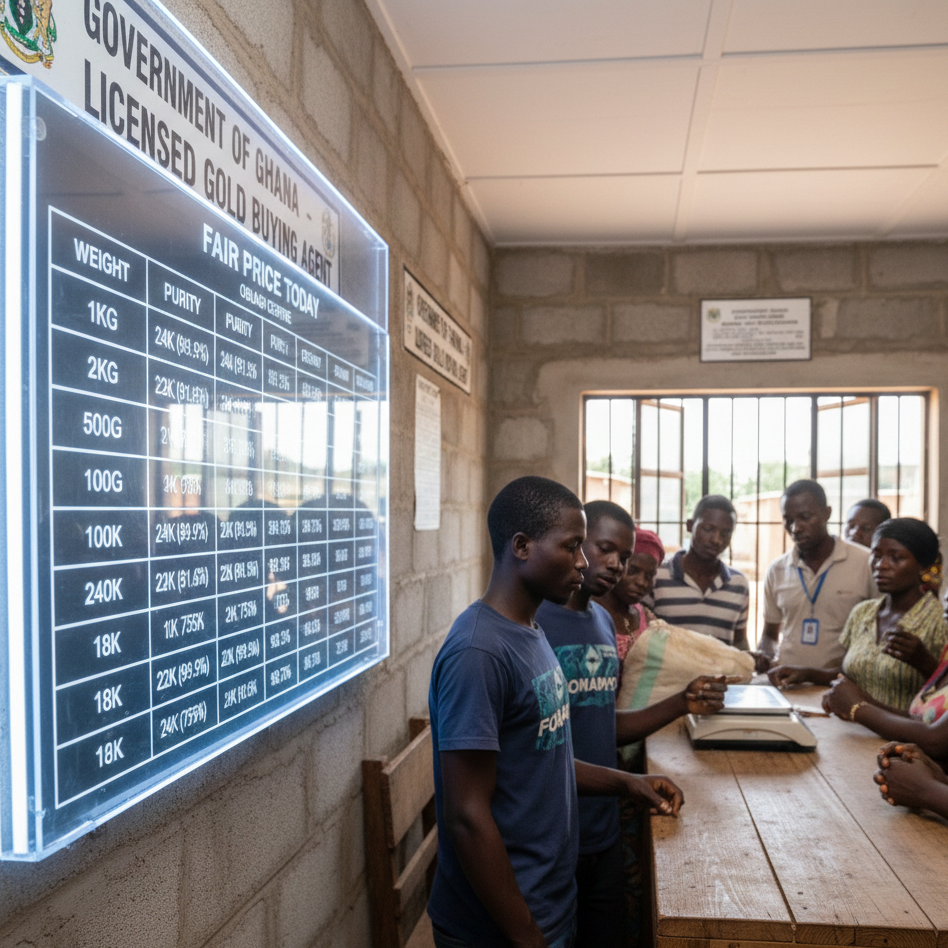
Ghana’s formalized market channels price gold within 1-2 percent of LBMA spot after mandatory assay verification at Precious Minerals Marketing Company facilities, with transparent competition among licensed buyers for small-scale miner production. South Africa’s industrial output trades through established corporate channels with pricing tightly coupled to international benchmarks, subject to South African Reserve Bank foreign exchange regulations and South African Revenue Service tax requirements—typically within 1-2 percent of spot for properly documented material. South Sudan’s emerging formal sector shows slightly wider spreads of 2-4 percent below spot reflecting logistical challenges in remote regions and limited competition among ministry-licensed aggregators—but still operating within realistic margins consistent with global commodity pricing principles. These modest differentials reflect legitimate operational costs rather than windfall opportunities.
Africa Gold Reserve’s Pricing Philosophy
Africa Gold Reserve, founded in 2015 and headquartered in South Africa, maintains transparent pricing strictly aligned with international benchmarks across its operations in Ghana, South Africa, and South Sudan. The company does not offer gold at artificially discounted rates—a practice associated with illicit supply chains—but provides value through supply chain efficiency, documentation reliability, and logistical integration. By maintaining direct relationships with licensed producers and eliminating speculative intermediaries, Africa Gold Reserve reduces handling costs that might otherwise inflate prices, passing these efficiencies to buyers while maintaining pricing integrity relative to LBMA benchmarks. Operations extend through the company’s United Kingdom office to facilitate settlement in major currencies and alignment with international trading conventions for clients across the UAE, United States, China, Europe, Asia, and Middle East.
Total Cost Considerations in Procurement
The true economics of African gold procurement extend beyond the per-ounce purchase price. Buyers must account for assay verification fees (0.1-0.3 percent of value), export permit costs, insurance premiums (0.2-0.5 percent), air freight expenses, and destination-market import duties. Material lacking complete documentation often incurs substantial delays, additional verification expenses at destination refineries, and potential customs penalties—effectively erasing any initial price advantage while creating compliance risks. Africa Gold Reserve’s model addresses total cost efficiency by providing fully documented shipments with assay certificates, export permits, and tax clearance verification—enabling smooth customs clearance and reducing hidden costs that undermine apparent price advantages from less rigorous suppliers.

Global Market Integration
African gold flows into identical international markets as material from other continents, subject to the same pricing pressures and quality standards. UAE refineries receiving South Sudan gold supplies, United States buyers importing Ghanaian production, and Chinese processors accepting South African doré all evaluate material against LBMA benchmarks without geographic premium or discount. Price arbitrage opportunities are fleeting and narrow—typically exploited by specialized trading desks with real-time market access rather than available to general buyers. Sustainable procurement relationships with trusted gold exporters like Africa Gold Reserve focus on supply security, documentation integrity, and logistical reliability rather than chasing marginal price differentials that often prove illusory when total transaction costs are calculated across established trade routes including South Sudan to UAE, Ghana to the United States, and South Africa to China.
Value Proposition Beyond Price
International buyers engage established African gold suppliers to address priorities that transcend minor price variations: documentation integrity for seamless customs clearance, supply consistency amid production fluctuations, and logistical reliability in moving material from remote sources to international departure points. Africa Gold Reserve mitigates these challenges through permanent regional offices across its operations in Ghana, South Africa, South Sudan, and the United Kingdom, direct relationships with licensed producers, and integrated export management. The company maintains visibility across the entire procurement chain—from acquisition through final export—providing buyers with complete documentation packages that reduce settlement risk and ensure material specifications match contractual terms. This operational excellence delivers sustainable value where price alone cannot.
Avoiding the “Discounted Gold” Trap
The persistent myth of substantially “discounted African gold” has fueled sophisticated advance-fee fraud schemes targeting international buyers. These operations promise gold at dramatic discounts, then request upfront payments for fictitious documentation, security escorts, or shipping fees before disappearing. Legitimate African gold exporters—including reputable South Africa gold exporters and Ghana gold exporters—never request advance payments before material verification and never offer gold at prices substantially below LBMA benchmarks. Buyers should verify exporter credentials through direct facility visits, documentation of prior shipments, and references from established industry participants. Price should be one factor among many in supplier selection—not the primary driver that overrides due diligence when seeking to buy gold from Africa.
For international buyers seeking African gold supply, value lies in supply chain integrity, documentation reliability, and operational transparency—not in illusory price advantages that often signal illicit activity or fraud. Africa Gold Reserve’s multi-year operational presence across Ghana, South Africa, and South Sudan—coupled with documented export history to global markets—provides buyers with legitimate access to African supply at market-reflective pricing. Success in African gold procurement depends on engaging established channels with procedural discipline rather than pursuing speculative discounts that compromise compliance and supply security in international gold trading.
africagoldreserve.com
sales@africagoldreserve.com